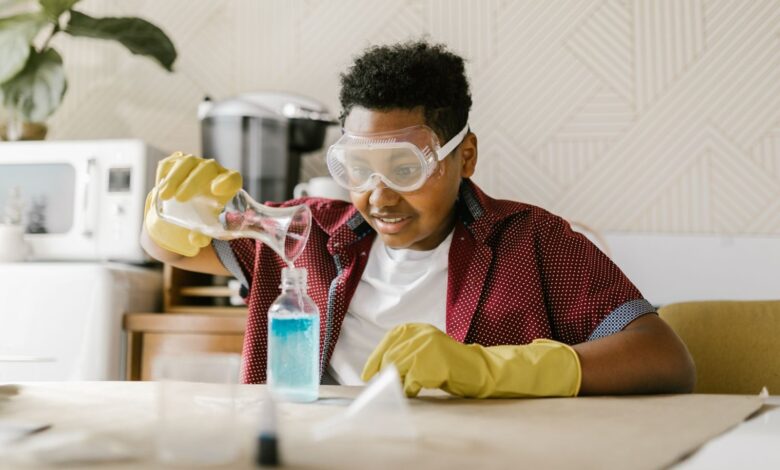
Easy science experiments for kids need nothing more than what is already in the kitchen: water, paper, vinegar, bicarbonate of soda, a balloon. The ten activities below each take about ten minutes to set up, show a result children can see and come with the real science behind it. For a bigger collection, the science experiments for kids to do at home hub has more.
Before you start: safety and tidy-up
Children should do these with an adult nearby. Cover the table or work on a tray, wash hands afterwards and treat everything as not for eating. Keep small items such as raisins, beads and balloon pieces away from children under five, who can choke on them (NHS, how to stop a child from choking, checked November 2026). Nothing on this page needs flames, bleach or boiling water.
What experiments can you do at home for kids?
Any visible change makes a good home experiment, whether that is something sinking, fizzing, spinning, dissolving or changing colour. These ten work reliably with ordinary household items.
1. Sink or float
You need: a large bowl of water and a handful of small objects such as a coin, a cork, a grape, a plastic spoon, a paper clip and a pebble.
- Ask your child to predict whether each object will sink or float and sort them into two piles.
- Place each object gently in the water and record what happens.
- Compare the results with the predictions.
The science: an object floats if it is less dense than the liquid, meaning it has less mass for its size. Water is the benchmark: anything denser sinks and anything less dense floats, and size or weight alone does not decide it (NASA StarChild, densities, checked November 2026). Try this next: add salt to the water and see if something that sank now floats.
2. Walking water
You need: three clear cups, water, food colouring (red and blue) and two paper towel strips.
- Line the cups up. Fill the outer two with coloured water and leave the middle one empty.
- Fold each strip, and put one end in a coloured cup and the other end in the empty cup.
- Wait and check every few minutes. The full result can take an hour or more.
The science: water climbs through the tiny gaps between the paper fibres, a process called capillary action. The two colours meet in the middle cup and mix to make a new colour.
3. Balloon inflated by a reaction
You need: a small plastic bottle, a balloon, a funnel, vinegar and bicarbonate of soda.
- Pour about 5 centimetres of vinegar into the bottle.
- Use the funnel to put two spoonfuls of bicarbonate of soda into the balloon.
- Stretch the balloon neck over the bottle and lift the balloon so the powder drops in.
The science: vinegar is a weak acid and bicarbonate of soda reacts with it to make carbon dioxide. The gas can only escape into the balloon, which inflates. The volcano experiment shows the same reaction with a different outcome.
4. Bend water with static
You need: an inflated balloon, a woollen jumper or dry hair and a tap.
- Rub the balloon on the wool for about 20 seconds.
- Turn the tap on to a thin, steady trickle.
- Bring the balloon close to the water without touching it.
The science: rubbing moves tiny charged particles called electrons from one material to the other, so the balloon ends up charged. A charged object attracts the water, so the stream bends towards it. The same charge lets the balloon stick to a wall or lift scraps of paper.
5. Dancing raisins
You need: a clear glass of fizzy water (sparkling water or lemonade) and a few raisins.
- Pour the fizzy drink into the glass.
- Drop in four or five raisins.
- Watch for a minute or two.
The science: bubbles of carbon dioxide gather on the wrinkled raisins and lift them to the top. At the surface the bubbles pop, the raisins lose their lift and sink, and the cycle starts again. Do not let young children eat the raisins afterwards, since they are a choking risk and have been in the drink.
6. Make a rainbow
You need: a clear glass of water, a sheet of white paper and a sunny window or a torch.
- Stand the glass on a table near the edge, with the paper on the floor beside it.
- Shine the light through the glass at an angle so it falls on the paper.
- Move the glass until you can see bands of colour.
The science: white light is a mixture of colours. When light passes through water it bends, and each colour bends by a slightly different amount, so the colours spread out into a rainbow.
7. Paper helicopters
You need: a strip of paper about 5 centimetres wide and 15 long, scissors and a paper clip.
- Cut a slit about halfway down the middle of the strip from the top.
- Fold the two flaps at the top in opposite directions to make blades.
- Fold the bottom up and add the paper clip, then drop it from a height.
The science: the blades catch the air and make the helicopter spin as it falls. Air resistance pushing up on the blades slows the fall compared with a ball of the same paper (NASA Glenn Research Center, terminal velocity, checked November 2026). Make it a fair test: change only the blade length, and drop each version from the same height.
8. Skittles rainbow
Arrange sweets in a circle on a plate, pour warm water into the middle and watch the colours spread without mixing. The colours spread because the sweet coatings dissolve, and the full method is in the Skittles experiment guide.
9. Oobleck
Mix cornflour and water for a substance that behaves like a solid when squeezed and like a liquid when you let it go. It is covered in how to make oobleck.
10. Red cabbage colour change
Red cabbage juice turns pink with vinegar and green or blue with bicarbonate of soda. Making it and testing household liquids is in the red cabbage indicator activity.
How do you explain science to a 7 year old?
Start with something they can see and touch, then ask what they think will happen before you reveal the result. Use their own words first and add the proper word afterwards: “the balloon is charged” works better than a lecture on electrons. Keep explanations to a sentence or two, and welcome “I don’t know, let’s test it”, which is how real investigations start.
What is the scientific method?
The scientific method is a way of finding out whether an idea is true by testing it. You ask a question, make a prediction, test it fairly, record what happens and decide whether the prediction was right. In a fair test only one thing changes at a time, so you know what caused the result. Add that structure and any activity above becomes a mini investigation.
What are the branches of science?
The three main branches taught in schools are biology (living things), chemistry (materials and how they change) and physics (forces, energy, light and electricity). Earth science and astronomy are often listed too. The experiments above cover all three: the balloon and raisins are chemistry, the static and helicopters are physics.
Quick guide to all ten experiments
| Experiment | Set-up time | Science idea |
|---|---|---|
| Sink or float | 2 minutes | Density |
| Walking water | 5 minutes, then wait | Capillary action, mixing colours |
| Balloon inflated by a reaction | 5 minutes | Acid and bicarbonate make a gas |
| Bend water with static | 3 minutes | Electric charge |
| Dancing raisins | 2 minutes | Gas bubbles and buoyancy |
| Make a rainbow | 5 minutes | Light bending in water |
| Paper helicopters | 10 minutes | Air resistance |
| Skittles rainbow | 5 minutes | Dissolving and diffusion |
| Oobleck | 5 minutes | Non-Newtonian fluids |
| Red cabbage colour change | 15 minutes | Acids and alkalis |
How to get more from each experiment
Ask for a prediction first
Before each test, ask what your child thinks will happen and why. A wrong prediction often teaches more than a right one, because the surprise sends children looking for the reason. Write the guess down so it can be checked afterwards.
Change one thing at a time
If you want to explore further, change a single variable and keep everything else the same. With the paper helicopter that might be the blade length, and with walking water the number of paper strips. Children soon find that two changes at once make the result impossible to read.
Record what you see
Drawing, tallying or timing keeps children looking carefully, and a simple table with one row per test is enough. Younger children can draw before and after pictures, and older children can measure with a ruler or a phone timer.
Repeat before you decide
One result can be a fluke. Run each test two or three times, particularly for the helicopter and sink or float, and see whether the answer stays the same. Scientists repeat their tests for the same reason.
Frequently asked questions
What is the easiest science experiment for kids?
Sink or float is the easiest. It needs only a bowl of water and some objects, takes a couple of minutes and suits any age.
What age are these experiments suitable for?
Most suit children from about four with an adult helping. Children under three need very close supervision and nothing small or edible-looking within reach, so see science experiments for toddlers.
How do I turn an experiment into a science project?
Pick one activity, write a question and a prediction, change one thing at a time and record the results in a table. A short written conclusion completes it.
Which easy experiment has the biggest wow factor?
The fizzing balloon and the bending water stream usually get the strongest reactions, since the result appears quickly. For party ideas, see Christmas science experiments.