Science Experiments for Kids to Do at Home
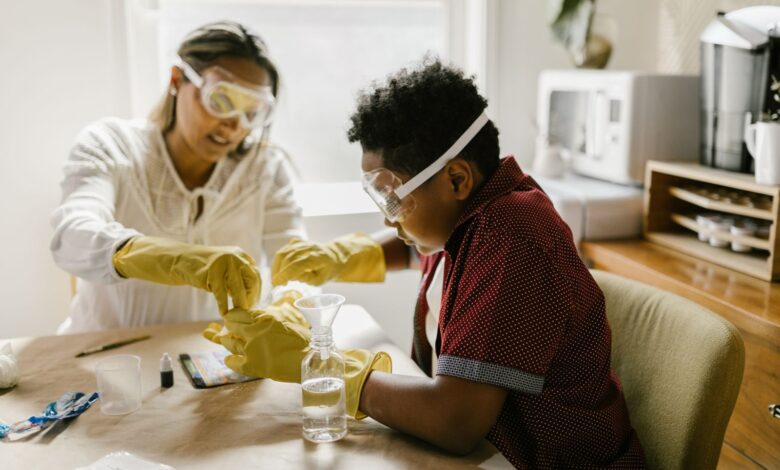
Most good science experiments for kids need nothing more than a kitchen cupboard, a tray and an adult who does not mind a bit of mess. This page collects a growing set of them written up in full, with the materials, the steps, what you should see and the science that explains it. Each one has a safety note, and every experiment is meant to be done by a child with an adult nearby.
The experiments are grouped by what they teach, so you can pick one to fit a topic from school, a rainy afternoon or a science fair. Start with the ones marked as easy if your child is under seven.
Before you start: a few house rules
- Work on a tray or a wipe-clean table, and keep a cloth handy.
- An adult handles anything hot, sharp or labelled as an irritant. Where a step needs an adult, the article says so.
- Nothing from an experiment gets eaten or drunk unless the article says it is food and safe to taste. Most are not.
- Wear old clothes. Safety glasses cost a few pounds and are worth having for the fizzing and fountain experiments.
- Wash hands afterwards, and read the label of any household product before you use it.
If a child swallows something they should not have, the NHS has advice on what to do about poisoning.
Fizzing and foaming: chemical reactions you can see
A chemical reaction makes new substances. In these experiments the new substance is usually a gas, which is why they bubble, foam or spray.
- Baking soda volcano. Bicarbonate of soda and vinegar make carbon dioxide gas. Easy, ages 3 and up with help.
- Elephant toothpaste. Yeast breaks down hydrogen peroxide so fast that the oxygen whips washing-up liquid into a tower of foam. Ages 6 and up, adult handles the peroxide.
- Mentos and Coke fountain. This one is physics as much as chemistry: dissolved gas escapes all at once from the sweet’s rough surface. Outdoors only.
Colours and changes: acids, alkalis and dissolving
- Red cabbage indicator. Cabbage juice turns red, purple, blue or green depending on whether a liquid is acidic or alkaline. Ages 5 and up.
- Skittles rainbow. Warm water dissolves the sugar coating and the colours spread out without mixing. Easy, ages 3 and up.
- Invisible ink. Two ways to write a secret message: lemon juice revealed by heat, and bicarbonate of soda revealed by grape juice. Ages 5 and up.
Forces and strange materials
- Oobleck. Cornflour and water make a liquid that turns solid when you hit it. Easy, ages 2 and up with supervision.
Electricity
- Potato battery. A zinc nail and a copper coin in a potato make a small electric cell. Three in a row will light an LED. Ages 7 and up.
Plants and living things
The photosynthesis equation explained covers how plants make their own food, with a pondweed experiment you can do at home with a jar, a lamp and some water plants.
Choosing an experiment by age
| Age | Good first experiments | What the adult does |
|---|---|---|
| 2 to 4 | Oobleck from age 2; Skittles rainbow and baking soda volcano from age 3 | Pours and measures; the child mixes and watches |
| 5 to 7 | Red cabbage indicator, invisible ink (grape juice method), volcano | Handles hot water and anything that stings |
| 8 to 11 | Potato battery, elephant toothpaste, Mentos and Coke | Handles hydrogen peroxide; supervises outdoors |
| 11 and up | Pondweed and photosynthesis, any of the above turned into a fair test | Checks the method and the safety plan |
Turning an experiment into a science fair project
A demonstration shows something happening. A project asks a question and tests it. Almost every experiment on this page can become a project by changing one thing and keeping everything else the same. For example:
- Does warm vinegar make a bigger volcano than cold vinegar?
- Which fizzy drink gives the tallest Mentos fountain?
- Does the number of potatoes change how bright the LED glows?
- Does the water temperature change how fast the Skittles colours spread?
Write down a prediction before you start, measure the result the same way each time, and repeat it at least three times. If the results disagree, that is worth reporting too.
Why bother with home experiments?
The science national curriculum for England asks primary pupils to work scientifically: ask questions, set up simple tests, observe closely and record what they find. A cupboard experiment practises every one of those steps. It also gives a child a memory to hang the idea on, which helps later when the same idea turns up in a textbook as “a gas is produced” or “the solution is alkaline”.
We add new experiments regularly. Each one is checked against reliable sources before it goes up, and if you spot a mistake, tell us through the contact page and we will put it right.