
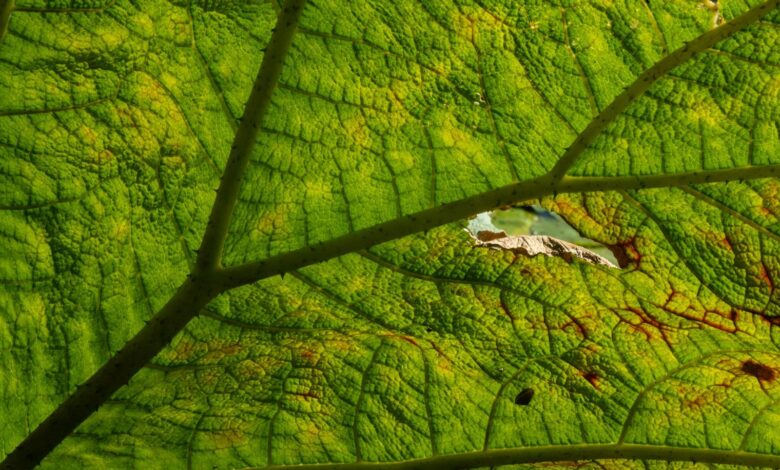
Photosynthesis is how green plants make their own food from light, water and air. The word equation is:
carbon dioxide + water → glucose + oxygen
Light energy is needed for the reaction, and it is absorbed by the green pigment chlorophyll. In exam answers, write “light” and “chlorophyll” above or below the arrow, because they make the reaction happen but are not used up as ingredients.
The balanced symbol equation is:
6CO2 + 6H2O → C6H12O6 + 6O2
That reads as six molecules of carbon dioxide and six molecules of water making one molecule of glucose and six molecules of oxygen. This page explains each part of the equation, where the reaction happens and what speeds it up, and ends with an experiment you can do at home with pondweed.
The equation, piece by piece
| Part | Formula | Where it comes from or goes |
|---|---|---|
| Carbon dioxide | CO2 | Taken in from the air through tiny pores on the underside of leaves, called stomata |
| Water | H2O | Taken up from the soil by the roots and carried to the leaves in tubes called xylem |
| Light | (energy, not a substance) | Absorbed by chlorophyll in the leaf |
| Glucose | C6H12O6 | A sugar the plant uses for energy and as a building material |
| Oxygen | O2 | Released into the air through the stomata, or used by the plant’s own cells |
How to remember it
The symbol equation is easy to rebuild if you remember that the numbers in front are all 6. Count the atoms on each side to check it balances: 6 carbon, 12 hydrogen and 18 oxygen atoms on the left, and the same on the right.
Is photosynthesis endothermic or exothermic?
Photosynthesis is endothermic. It takes in energy from its surroundings, in the form of light, and stores it in the chemical bonds of glucose. Respiration does the reverse: it breaks glucose down and releases that energy, so respiration is exothermic.
Where does photosynthesis take place?
Photosynthesis happens inside chloroplasts, which are small structures found in plant cells and in algae. Chloroplasts contain chlorophyll, which makes them green.
In most plants, the leaves do almost all of the work. Leaves are thin and flat, so light can reach most of their cells and gases do not have far to travel. The cells packed most tightly with chloroplasts are the palisade cells, which sit in a row just under the upper surface of the leaf where the light is strongest.
What does the plant do with the glucose?
Glucose is the start of almost everything a plant makes. A plant uses it to:
- release energy through respiration
- make cellulose, which builds strong cell walls
- make starch, which stores energy (this is why potatoes and seeds are full of starch)
- make fats and oils, often stored in seeds
- make proteins, by combining it with nitrates taken up from the soil
Because animals eat plants, or eat other animals that ate plants, the glucose made in photosynthesis is the original source of energy in nearly every food chain. The oxygen it releases is what most living things breathe.
Limiting factors of photosynthesis
The rate of photosynthesis depends on a few conditions. Whichever one is in shortest supply holds the rate back, and that one is called the limiting factor.
- Light intensity. More light means faster photosynthesis, up to a point. On a dull winter day, light is usually the limiting factor.
- Carbon dioxide concentration. Air contains only about 0.04% carbon dioxide. Commercial greenhouses sometimes add extra to make crops grow faster.
- Temperature. Photosynthesis is controlled by enzymes, which work faster as they warm up. Above roughly 40 to 45°C in most plants, the enzymes start to be damaged and the rate drops sharply.
Chlorophyll can also be a limiting factor if a plant is short of minerals such as magnesium, which it needs to make chlorophyll. Leaves then turn yellow.
On a graph of rate against light intensity, the line rises and then flattens. Where it flattens, something other than light has become the limiting factor. BBC Bitesize has a revision guide to limiting factors, written for Scotland’s National 5 course, that covers the same ground as GCSE.
Try it at home: counting bubbles from pondweed
This is a simple version of the GCSE required practical on the rate of photosynthesis. You can see oxygen being made.
What you need
- A few sprigs of oxygenating pondweed from an aquarium shop or garden centre
- A clear glass or jar of water
- Half a teaspoon of bicarbonate of soda, which adds carbon dioxide to the water
- A desk lamp with an LED bulb
- A ruler and a timer
Steps
- Stir the bicarbonate of soda into the water.
- Cut the end of a pondweed sprig cleanly and put it in the jar with the cut end at the top. A paperclip will keep it under the surface.
- Place the lamp 10 cm from the jar and wait two minutes.
- Count the bubbles rising from the cut end for one minute. Those bubbles are mostly oxygen.
- Move the lamp to 20 cm, then 30 cm, waiting two minutes each time before counting again.
- Draw a graph of bubbles per minute against distance.
You should see fewer bubbles as the lamp moves further away, because less light reaches the plant. Use an LED lamp because older bulbs give off heat, and warming the water would change the temperature as well as the light, which spoils the test.
Safety: keep the lamp and its cable away from the water, and dry hands before touching the switch. Wash hands after handling pondweed. Never release aquarium or pond plants into rivers, canals or wild ponds: several pondweeds, including Canadian pondweed, are invasive in the UK.
Photosynthesis and respiration compared
| Photosynthesis | Respiration | |
|---|---|---|
| Happens in | Plants and algae, in chloroplasts (and some bacteria) | All living cells, in mitochondria (aerobic) |
| Takes in | Carbon dioxide and water | Glucose and oxygen |
| Gives out | Glucose and oxygen | Carbon dioxide and water |
| Energy | Taken in (endothermic) | Released (exothermic) |
| When | Only in the light | All the time, day and night |
Plants respire all the time as well. In bright light they photosynthesise much faster than they respire, so overall they take in carbon dioxide and give out oxygen. At night they only respire.
Common questions
What are the reactants and products of photosynthesis?
The reactants are carbon dioxide and water. The products are glucose and oxygen.
Is light a reactant?
No. Light is energy rather than a substance, so it goes above the arrow with chlorophyll, which absorbs it.
Do plants photosynthesise at night?
No, because there is no light. They carry on respiring, so at night a plant gives out carbon dioxide.
BBC Bitesize has a short guide to photosynthesis for younger pupils. For hands-on science, see our guide to science experiments for kids to do at home.


