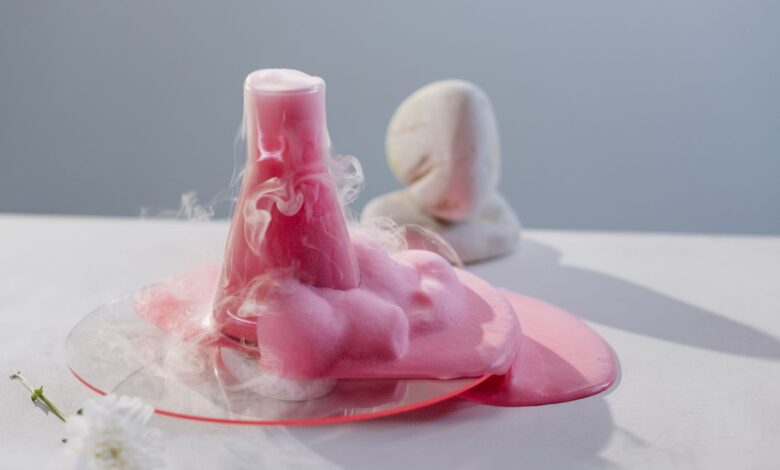
Elephant toothpaste is the experiment where a small bottle suddenly pours out a thick column of foam, as if an elephant were squeezing a tube. The big versions on video use strong chemicals that belong in a school lab. The home version below uses the 3% hydrogen peroxide sold in UK pharmacies and dried yeast from the supermarket. The foam is smaller and slower, but the chemistry is the same.
What you need
- A clean plastic bottle, about 500 ml, with a narrow neck
- 120 ml (half a cup) of 3% hydrogen peroxide solution, from a pharmacy
- 1 sachet (7 g) of dried yeast
- 3 tablespoons of warm water (warm to the touch, not hot)
- A good squirt of washing-up liquid
- Food colouring (optional)
- A small cup, a funnel and a spoon
- A large tray, a washing-up bowl or a spot outside
- Safety glasses and disposable gloves for the adult
Time: 10 minutes. Age: 6 and up, with an adult handling the hydrogen peroxide.
Step by step
- Stand the bottle on the tray. Everyone near the bottle puts on safety glasses.
- Adult: wearing gloves, use the funnel to pour the hydrogen peroxide into the bottle.
- Add the washing-up liquid and a few drops of food colouring. Swirl the bottle gently to mix.
- In the cup, stir the yeast into the warm water for about 30 seconds until it looks like thin cream. Leave it for a minute or two.
- Pour the yeast mixture into the bottle through the funnel, take the funnel away quickly and step back.
- Watch the foam rise out of the neck and spill over. Touch the side of the bottle: it will feel warm.
What is happening?
Hydrogen peroxide (H2O2) slowly breaks down on its own into water and oxygen gas. It does this so slowly that a bottle on the shelf lasts for months. Yeast speeds it up enormously because yeast cells contain an enzyme called catalase. An enzyme is a protein that makes a particular reaction happen faster without being used up, so a small amount of yeast can break down a lot of peroxide.
The reaction is:
hydrogen peroxide → water + oxygen
2H2O2 → 2H2O + O2
On its own, the oxygen would just bubble out and escape. The washing-up liquid traps it in millions of small bubbles, and the foam has nowhere to go but up the neck of the bottle. That is your elephant toothpaste.
The bottle gets warm because the reaction gives out heat, which makes it exothermic. The foam is mostly water, soap, oxygen and spent yeast.
Living things carry catalase for a reason. Cells make small amounts of hydrogen peroxide as a by-product of normal chemistry, and it would damage them if it built up, so the enzyme breaks it down quickly. It is the same reason a drop of peroxide on a cut potato fizzes.
Safety
- Only use 3% hydrogen peroxide for this at home. Stronger solutions can burn skin and eyes, and in the UK the stronger grades are restricted for sale to the public. The large demonstrations online use around 30% peroxide with potassium iodide, which is a job for a trained teacher with proper protection.
- Even at 3%, peroxide can irritate eyes and skin. The adult pours it, wearing gloves, and everyone wears glasses. If any gets in an eye, rinse with plenty of clean water and get medical advice.
- Do not touch the foam until the reaction has stopped. Afterwards it is safe to touch with clean hands, but nobody should taste it.
- Rinse everything with water when you have finished. The leftover liquid can go down the sink with plenty of running water.
- Keep the peroxide bottle closed, labelled and out of reach of children.
Ideas for a fair test
- Does the temperature of the yeast water change how fast the foam rises? Try cool, warm and hand-hot water. Enzymes work faster as they warm up, until they get too hot and stop working.
- Does the shape of the bottle change the height of the foam? Compare a narrow neck with a wide jar.
- Does more washing-up liquid make more foam, or just thicker foam?
Measure the height of the foam against a ruler taped to the wall behind the bottle, and film each run on a phone so you can check the time.
Common questions
Can you make elephant toothpaste without hydrogen peroxide?
No. The foam comes from oxygen, and the oxygen comes from the peroxide. If you want a foaming reaction without peroxide, the baking soda volcano uses bicarbonate of soda and vinegar and gives off carbon dioxide instead.
Why is it called elephant toothpaste?
Because the foam squeezes out of the bottle neck like toothpaste from a giant tube. The name has stuck in school labs for decades.
The chemistry is described in more detail on the Wikipedia page for elephant’s toothpaste. For more experiments, see our guide to science experiments for kids to do at home.