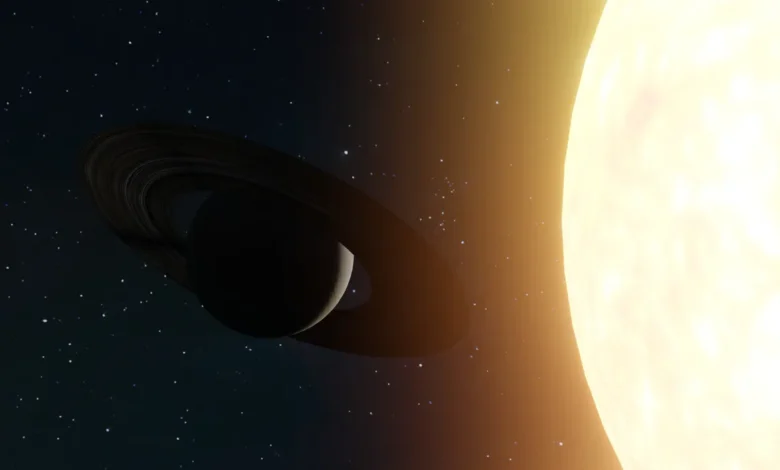
A study of 21 Webb extreme debris disks around young stars has given astronomers their clearest picture yet of the planetary collisions that may have forged rocky worlds, including the impact thought to have produced the Moon. The findings, published on 1 October in The Astrophysical Journal, were led by Kate Su of the Space Science Institute in Boulder, Colorado.
A Subclass Two Decades in the Making
The story of extreme debris disks begins not with Webb but with its predecessor. According to the Space Telescope Science Institute, approximately 20 years ago the Spitzer Space Telescope first uncovered this enigmatic subclass of circumstellar disks, rings of dust and rock orbiting mature stars whose properties did not fit neatly into existing models. What Spitzer lacked was the spectral resolution to say much about their composition. That is where Webb comes in.
Extreme debris disks contain exceptionally large amounts of warm dust sitting close to their host stars, roughly in the same orbital region where rocky planets circle in our own solar system. They differ sharply from the colder, better-understood debris disks such as those around the stars Vega and Fomalhaut. Theoretical models suggest they should be relatively common, yet observations indicate that only about 1% of young stars display detectable signs of this stage.
Su’s team assembled a sample of 21 such systems: five drawn from archival Spitzer observations and 16 examined with Webb, of which 12 were newly observed and four were follow-up studies of systems Spitzer had already flagged. ‘This is the first time we have gathered enough systems to truly understand this subclass that we call extreme debris disks,’ Su said. ‘Before Webb, we had limited information.’
Webb Extreme Debris Disks Split Into Two Populations
Mid-infrared spectra from Webb and Spitzer confirmed three defining characteristics shared by all 21 disks: dust grains smaller than those in protoplanetary or typical debris disks, unusually high concentrations of warm dust, and brightness that changes irregularly over time. Analysing the minerals present, the researchers divided the sample into two broad groups: silica-rich disks and silica-poor disks.
The distinction matters because mineralogy encodes the physics of the collision that produced the debris. Sci.News reports that crystalline silicates such as forsterite can form through condensation or through annealing, a process in which existing dust is heated and restructured. Whether a disk ends up silica-rich or silica-poor may therefore depend not only on the energy of the original impact but on how the resulting debris subsequently evolves.
Roughly one-third of the disks are silica-rich. The researchers say these systems likely formed after extremely energetic collisions between Mars-sized bodies, impacts powerful enough to vaporise a substantial quantity of rocky material. The remaining two-thirds are silica-poor, appearing to result from lower-energy events, including grazing impacts between Moon-sized objects. Agnes Kospal of Konkoly Observatory in Budapest, Hungary, and a coauthor of the study, described the spectral data as the most exciting aspect of the work. ‘We have no other way to study these planetary embryos directly because they are too small,’ she said.
There is also an age difference between the two populations. Silica-rich disks have been found only around stars younger than 300 million years, whereas silica-poor disks occur around stars spanning a much wider range of ages and tend to show stronger changes in brightness. The team suggests that this variability may arise from the rapid evolution of freshly produced debris, driven by changes in the material’s orbit and additional collisions.
Attila Moor, also of Konkoly Observatory and a coauthor, noted that the sample of older disks remains thin. ‘We only have three disks in our sample that fit that age criteria, so it’ll be nice to observe more of these systems to confirm our hypothesis,’ he said.
What the Disks May Reveal About Our Own Solar System
Scientists think the early solar system saw a colossal collision between the young Earth and a Mars-sized body known as Theia, an event that likely vaporised vast quantities of rock and hurled material into orbit, some of which coalesced into the Moon. The ages of the silica-rich extreme debris disks observed so far are consistent with computer simulations suggesting terrestrial planets should emerge within the first few hundred million years after a solar system begins forming, and with estimates that Earth and the Moon formed roughly 100 million years after the Sun.
The silica-poor disks raise a separate question: whether the Sun passed through a similar phase at a later stage. If their apparently random periods of changing infrared brightness are caused by orbital instability, the pattern would be broadly compatible with the Late Heavy Bombardment hypothesis, under which the giant planets shifted significantly from their original positions, disturbing smaller bodies and setting off cascading collisions.
‘How rocky planets formed and giant planets evolved are part of the broader story of the solar system’s formation,’ Su said. ‘It’s all one story.’ NASA, along with its partners ESA and CSA, leads the James Webb Space Telescope programme, and the team expects further observations to test whether silica-rich systems are genuinely absent among older extreme debris disks, as the current data suggest.