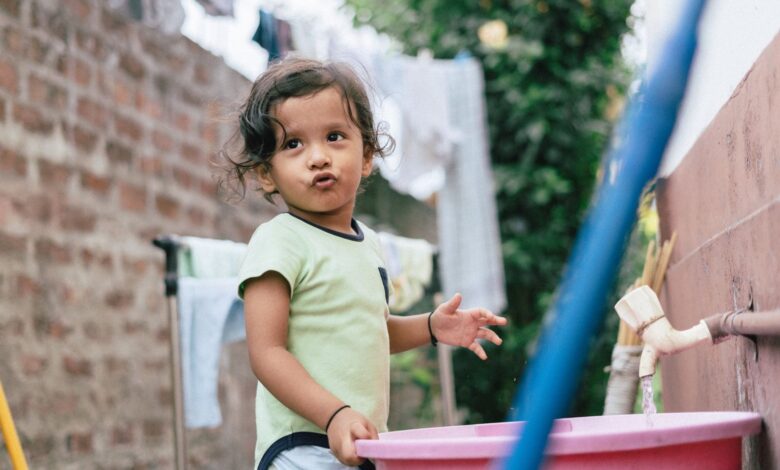
The best science experiments for toddlers are simple, hands-on and safe to touch: water play, ice, bubbles, ramps, colour mixing and shadows. At ages one to three, children do not need an explanation of the science. They need to see something change, try it again and hear you name what is happening, with a safety plan that assumes everything goes in the mouth. This guide gives nine activities with materials, steps and the idea behind each, and sits alongside the wider science experiments for kids collection for older children.
Safety first for toddler science
Toddlers put things in their mouths, tip things over and move quickly, so plan each activity around that. These points come from NHS advice (checked November 2026).
- Choking: keep small objects such as buttons, coins and small toy parts out of reach (NHS, baby and toddler safety). Use large, chunky items only, and nothing a child could fit in their mouth.
- Water: babies can drown in as little as 5cm of water, and the NHS advises staying with babies and toddlers the whole time they are in the bath or near a paddling pool (NHS, baby and toddler safety). Stay within arm’s reach of any bowl or tray of water, and empty it afterwards.
- Household products: keep cleaning products and laundry capsules out of reach. Do not use them for experiments with toddlers.
- Eating: nothing here is for eating. Wash hands before and after, and use one activity at a time.
An adult should hold the vinegar, the food colouring and any warm water. For more on choking risks see NHS, how to stop a child from choking.
What activities can 2 to 3 year olds do?
Children aged two to three can pour, squeeze, scoop, stir, roll and watch, so almost every activity below suits them. For one year olds, keep things simpler and stay closer, and for three year olds, add a question such as “what do you think will happen?”. Keep sessions short. Five to ten minutes is plenty, and a child who stops while still enjoying it will want to do it again.
Nine easy science activities for toddlers
1. Sink or float in a washing-up bowl
You need: a large washing-up bowl or tub half filled with water and chunky objects: a plastic cup, a sponge, a large wooden spoon, a big plastic toy, a pine cone.
- Show your child one object and say “float or sink?”.
- Let them place it in the water and watch.
- Repeat with the others, naming what happens.
The science: objects that are less dense than water float and objects that are denser sink (NASA StarChild, densities, checked November 2026). Toddlers do not need the word density, only sink and float.
2. Rescue the frozen toys
You need: a plastic container, a few large toy animals or plastic shapes (nothing small), water, a freezer and a jug of warm tap water that an adult has checked is not hot.
- Freeze the toys in a block of water in the container overnight.
- Put the block in a tray and give your child a spoon, a squeezy bottle of warm water or a pipette.
- Let them melt the ice to free the toys.
The science: the warm water passes its heat to the ice, which turns back to liquid water.
3. Colour mixing
You need: three clear plastic cups of water, red, yellow and blue food colouring, a spoon and a tray.
- An adult adds a few drops of one colour to each cup.
- Your child pours a little from one cup into an empty cup.
- Pour a second colour in and see what the mixture becomes.
The science: mixing two colours makes a new one: red and yellow give orange, and yellow and blue give green. Food colouring stains clothes, so use an apron.
4. Fizzing tray
You need: a baking tray, a few spoonfuls of bicarbonate of soda, a small cup of vinegar tinted with food colouring and a spoon.
- Spread the bicarbonate of soda in the tray.
- Give your child the cup of vinegar and a spoon, and let them drizzle it on.
- Talk about the bubbles and the sound.
The science: vinegar is an acid and bicarbonate of soda reacts with it to produce carbon dioxide gas, which makes the foam. Keep it away from eyes and mouths. The same reaction powers the volcano experiment.
5. Bubble play
You need: a bottle of ready-made bubble mix and a wand, or a bowl of water with a little bubble mix and a large slotted spoon.
- Blow a few bubbles and let your child pop them.
- Show how a wand dipped in the bowl makes a skin of liquid.
- Try different shaped wands.
The science: the soapy water forms a thin skin held together by surface tension, which stretches into a round shape around the air blown into it. Do not let toddlers drink the mixture, and wipe up spills, which make the floor slippery.
6. Ramps and rolling
You need: a firm piece of cardboard or a tray, a few books to prop it up and large soft balls, cars and a wooden block.
- Prop the board at an angle to make a ramp.
- Let your child roll each item down and watch which goes furthest.
- Raise or lower the ramp and see what changes.
The science: gravity pulls objects down the slope. A steeper ramp makes things roll faster, and round things roll while blocks slide or stop.
7. Torch and shadow play
You need: a torch, a plain wall or sheet and a few toys or your hands.
- Dim the room and shine the torch on the wall.
- Hold a toy in front of it so a shadow appears.
- Move the toy closer and further away and watch the shadow grow and shrink.
The science: a shadow forms where an object blocks light. The nearer the object is to the torch, the larger the shadow, and it shows toddlers early on that light travels in straight lines.
8. Cornflour goo
You need: a bowl, a few spoonfuls of cornflour and water.
- Add water to the cornflour a little at a time and mix with your fingers.
- Let your child squeeze and poke it, then let it drip.
The science: the mixture acts like a solid when pressed and a liquid when left. Adults can find the full explanation in how to make oobleck. It is not for eating, so supervise closely.
9. Grow cress
You need: a clear plastic pot, cotton wool, water and cress seeds.
- An adult places damp cotton wool in the pot and sprinkles on the seeds.
- Put the pot on a windowsill and ask your child to check it each day.
- Water a little whenever the cotton wool feels dry.
The science: seeds need water and warmth to start growing, and the shoots bend towards the light. Cress seeds are tiny, so keep them out of the mouth until you have finished.
How to set up a toddler science space
Choose a spot you do not mind getting wet: a kitchen floor, a patio or a large tray on a low table. Lay down a towel or an old sheet and put the materials in separate containers so your child can pick them up one at a time. Offering one new material at a time keeps the activity calm and makes it easier to see what your child notices.
Dress them in clothes that can get dirty, and have a cloth ready for spills. Keep adult-only items such as vinegar, food colouring and warm water on a high shelf until you need them, then hand them over a little at a time. Finish by washing hands and tidying together, a small routine toddlers tend to enjoy.
What do toddlers learn from science play?
Toddlers learn that actions have effects: tipping a cup empties it, squeezing a sponge releases water, pushing a ball makes it roll. They also practise pouring, gripping and balance, and pick up words like float, melt, fizz and slippery. You do not need to teach any of it. Name what happens in a few words and let them lead.
What are some other DIY science projects I can do?
Once your child is past three, try the activities in easy science experiments for kids, which has ten more with the science behind them. Wider ideas for older children are in STEM activities for kids.
Frequently asked questions
What is the best first science experiment for a toddler?
Sink or float in a bowl of water is the best place to start. It is quick, uses things you already own and teaches two words.
At what age can children start doing science experiments?
Babies and toddlers explore through touch and play from the earliest months. Simple experiments like water play suit children from around one year, with an adult within arm’s reach at all times.
How long should a toddler science activity last?
A few minutes is enough. Let your child decide when they have had enough, and put things away before interest fades.
Are food colouring and vinegar safe for toddlers?
Used in small amounts under supervision, they are common in toddler activities, but neither is for eating or drinking. Keep vinegar away from eyes and check labels on any colouring for age advice.