
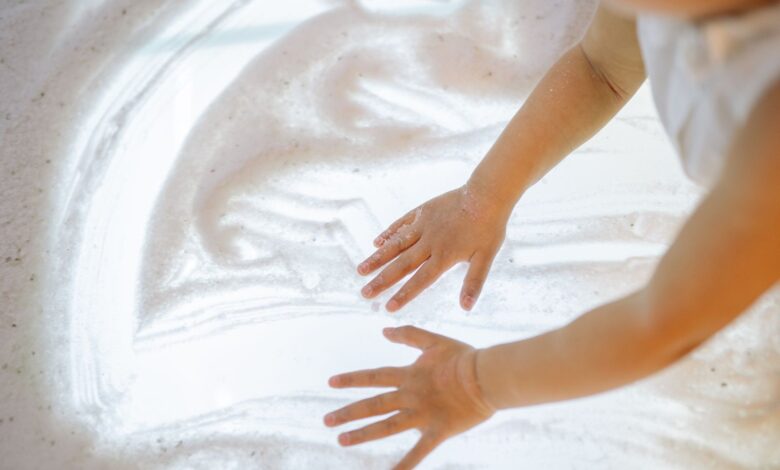
Oobleck is a mixture of cornflour and water that behaves like a liquid when you handle it gently and like a solid when you hit it. You can make it in two minutes with two ingredients, and it is one of the best ways to show a child that “solid” and “liquid” are not always as simple as they sound.
The name comes from Dr Seuss’s 1949 book Bartholomew and the Oobleck, in which a sticky green substance falls from the sky. Scientists call this kind of material a non-Newtonian fluid.
What you need
- About 2 mugs of cornflour (cornstarch in American recipes)
- About 1 mug of cold tap water
- A large bowl or a baking tray with sides
- A spoon
- Food colouring (optional)
- Old clothes or an apron, and a tray or mat underneath
Time: 5 minutes to make, as long as you like to play. Age: 2 and up with an adult watching.
How to make oobleck
- Tip the cornflour into the bowl.
- If you want colour, add a few drops of food colouring to the water first. It spreads more evenly that way.
- Pour in about half the water and stir slowly. The spoon will start to feel stiff.
- Keep adding water a little at a time until the mixture flows off the spoon when you lift it slowly but feels firm when you tap it. Most batches end up at roughly 2 parts cornflour to 1 part water, but cornflour brands vary, so go by feel.
- If it is too runny, add a spoonful of cornflour. If it cracks and will not flow, add a splash of water.
Things to try
- Punch it. Hit the surface quickly with your fist. It feels like hitting a firm cushion, and your hand does not go in.
- Sink into it. Now rest your fingers on the surface. They slowly sink to the bottom.
- Make a ball. Scoop some up and roll it quickly between your palms. It holds together as a ball while you keep rolling. Stop, and it melts through your fingers.
- Drop a toy on it. A small plastic figure dropped from a height bounces or sits on top. Placed gently, it sinks.
- Pull it slowly and fast. Draw a spoon through it slowly and it parts. Yank the spoon and the oobleck grabs it.
What is happening?
Cornflour does not dissolve in water. It stays as billions of tiny solid grains floating in the water, which is called a suspension.
When you move slowly, the water has time to flow between the grains, and they slide past each other like people walking calmly through a crowd. The mixture pours.
When you hit it, you push the grains together faster than the water can get out of the way. They jam against each other and lock into a temporary solid network. As soon as the force stops, water flows back between them and the mixture runs again. Thickening under a sudden force like this is called shear thickening.
Most liquids you know, such as water or cooking oil, are Newtonian: how thick they are does not change when you stir them harder. Oobleck breaks that rule, and so do some other everyday materials. Ketchup does the opposite and gets runnier when you shake it, which is why a hard tap on the bottle gets it moving.
Engineers have studied shear-thickening fluids for things like flexible body armour and sports padding, which stay soft until a sudden impact makes them stiffen. The oobleck article on Wikipedia has more on the physics and the famous videos of people running across pools of it.
Safety and clean-up
- Cornflour and water are not harmful to touch, but oobleck is not food. Supervise small children so it does not end up in mouths, and keep the dry cornflour away from faces, as the powder can be breathed in.
- Food colouring can stain hands, clothes and grout for a day or two.
- Do not pour oobleck down the sink or toilet. The cornflour settles in pipes and can block them. Let it dry out on the tray, then scrape the powder into the bin.
- Dried oobleck on clothes brushes off, and the rest comes out in a normal wash.
Make it a fair test
For an older child, oobleck makes a good first investigation. Try changing one thing at a time:
- Does the ratio of cornflour to water change how high a marble bounces off it?
- Does warm water make it behave differently from cold water?
- Does potato starch or arrowroot work as well as cornflour?
Keep everything else the same, measure the same way each time, and repeat each test three times.
Common questions
Can you make oobleck without cornflour?
Potato starch and arrowroot also work, because they are also fine starch grains that do not dissolve in cold water. Plain flour does not work well: it makes a sticky paste because it contains gluten and other proteins.
How long does oobleck last?
Covered, it keeps for a day or so. The water slowly evaporates and it can start to smell after a couple of days, so it is best made fresh.
Is oobleck a solid or a liquid?
It is a liquid with solid grains in it. It only acts like a solid while a force is pushing the grains together.
Find more experiments in our guide to science experiments for kids to do at home.


