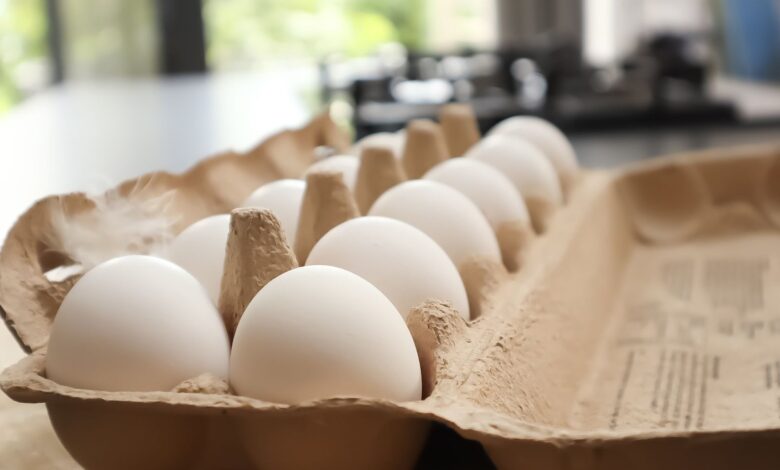
The egg drop challenge asks you to build a package that lets a raw egg fall from a set height and land without cracking. The designs that work do two things: they slow the fall with air resistance, and they make the egg stop gently by spreading the landing over as much distance as possible. This guide explains the physics, shows designs to build and gives you a fair way to compare them. It is one of the best projects in the wider science experiments for kids collection.
What is the point of the egg drop project?
The point is to learn how forces work by trying to protect something fragile. Children design a package, predict what will happen, drop it, see whether it survives and improve it. Engineers work in the same cycle of design, test and redesign, and teachers use the project for STEM lessons for that reason (see STEM activities for kids for more like it). A NASA activity sheet uses the same task to link a falling object’s speed and acceleration to the force it feels when it lands (NASA egg drop activity, checked November 2026).
What you need
- Raw eggs, plus a few spares and a hard-boiled egg or two for practice
- Cushioning: sponge, cotton wool, bubble wrap, shredded paper, foam, cereal or popcorn
- Structure: a small box or plastic pot, drinking straws, lolly sticks, cardboard, tape
- For a parachute: a plastic bag or scrap fabric, string and scissors
- A tray or plastic sheet to catch the mess, and a tape measure
Safety and ground rules
Drop outdoors or onto a surface that can be wiped clean. A child should never climb on furniture or a ladder to drop the package, and an adult should do any drop from above head height. Stay clear of the landing zone, keep other children back, and wash hands after touching raw egg. Do not eat the egg afterwards.
Agree the rules before building: the drop height, the maximum weight or size of the package, and the materials allowed. Fixed rules keep the results fair.
The physics of the egg drop
Why does an egg break?
An egg breaks when the force on its shell at landing is too large for the shell to take. The shell is strong when pressed evenly from the ends and weak when hit at one point or on its side. Cutting the force or spreading it out keeps the egg whole.
Falling speed and air resistance
The longer an object falls, the faster it goes, until the push of air upwards (drag) matches its weight. That speed is called terminal velocity, and objects with a larger area facing the air or a draggier shape reach a lower one, while heavier objects reach a higher one (NASA Glenn Research Center, terminal velocity, checked November 2026). A parachute or a wide flat surface adds area and drag, so the package lands more slowly.
From a drop of two metres the package is travelling at about 6 metres per second when it lands, from the standard formula for a fall without air resistance. A parachute lowers that number, though over a short school-height drop it may not have time to open fully.
Stopping distance and impulse
For a given landing speed, the egg’s momentum has to fall to zero. The force needed depends on how long the stop takes: stretch the stopping time and the force gets smaller. Airbags and bike helmets are padded for the same reason.
A quick calculation shows the effect. Stopping from 6 metres per second over 1 centimetre needs an average deceleration of about 180 times the pull of gravity. Stop over 10 centimetres instead and it falls to about 18 times, so ten times the cushioning distance gives a tenth of the force.
What material is best for an egg drop?
The best materials are light and squash gradually over a few centimetres, so they absorb the landing without bouncing the egg back. Sponge, foam, crumpled paper, cotton wool, bubble wrap and cereal all do this. Stiff, thin padding is the worst choice: it stops compressing after a millimetre or two and passes the force straight to the egg.
| Design idea | What it does | Watch out for |
|---|---|---|
| Parachute | Adds drag, so the package lands more slowly | Tangled strings; needs height to open |
| Thick padding all round | Spreads the stop over several centimetres | Too much weight raises the landing speed |
| Straw crumple zone | Straws bend and absorb energy on impact | Straws must be able to collapse, not just snap |
| Cage of lolly sticks | Holds the egg in the middle, away from the ground | Needs padding inside too |
| Balloon or air pocket | Compresses to cushion the stop | Can burst or bounce the egg |
Egg drop designs that work
The padded box
Put the egg in a small box and surround it on every side with at least 3 centimetres of padding. Make sure the egg cannot rattle, because a loose egg gets a second impact when it hits the side. It is the simplest design and a good first attempt.
The parachute pod
Tie four to six strings to the corners of a plastic bag or square of fabric and attach them to a light pod holding the egg. Fold the parachute loosely so it opens quickly. The pod still needs padding, because a parachute rarely brings the speed low enough on its own.
The straw frame
Tape straws into a cube or ball around the egg so that any impact is taken by the straws first. Because each straw bends before it breaks, the frame acts as a crumple zone, like the front of a car. Add a layer of cotton wool between the egg and the straws.
The mixed design
The most reliable entries combine ideas, with a straw frame for structure, padding next to the egg and a modest parachute on top. Keep the total weight low, since extra mass means extra force on landing.
Make it a fair test
To compare designs, change one thing at a time. Drop each design from the same height onto the same surface, use eggs of the same size and keep the package weight within the agreed limit. Weigh each package and note the result: pass or crack. Then ask what to change, such as adding 2 centimetres of padding or a bigger parachute, and drop again. Hard-boiled eggs are useful for practice drops because they show cracks without the mess.
What is the highest egg drop ever done?
The Guinness World Record for the greatest height from which a protected egg was dropped without breaking is 25.3 metres, set by five students in West Chester, USA, on 18 August 2024 (Guinness World Records, checked November 2026). Check the page for the current figure in case it has been beaten.
What other experiments can you do with eggs?
Eggs suit other experiments too. Place one in a glass of vinegar for a couple of days and the shell slowly dissolves, because the acid reacts with the calcium carbonate in it and releases carbon dioxide, the same gas as in the volcano experiment. You can also test whether an egg floats in fresh water and in very salty water. Salt makes water denser, so an egg that sinks in tap water floats in strong salt water (NASA StarChild, densities, checked November 2026). If you would like more projects with household items, try easy science experiments for kids.
Frequently asked questions
What height should we drop the egg from?
Start low, around one to two metres, and increase it each round. A low first drop shows whether the basic design works, and you can raise the height to test the improved versions.
Do parachutes help in an egg drop?
Yes, when the drop is high enough for the parachute to open. It lowers the landing speed by adding drag. For short drops, padding does most of the work.
Why did my egg break even with lots of padding?
Common reasons are a loose egg that moved inside the package, padding that was too thin or too stiff, or a package that landed on one hard corner. Check where the crack is, as it points to where the force arrived.
Is it safe to use raw eggs with children?
It is safe with ordinary care. Contain the mess, wash hands after handling and do not eat the egg. If an egg gets on a surface, wipe it with hot soapy water.
What age is the egg drop challenge for?
Younger children enjoy it with an adult doing the drop, and older children can add measurement and calculations. Change the rules to suit the age, not the activity.