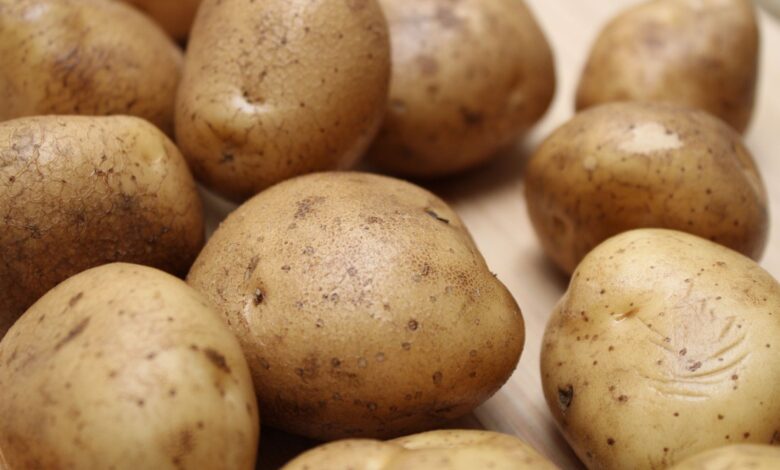
A potato battery uses two different metals pushed into a potato to make a small electric current. One potato gives less than a volt, which is not enough to light a bulb, but connect three in a row and you can light a small LED. It is a good way to show where the electricity in a battery comes from, and the answer is not quite what most people expect.
What you need
- 3 or 4 potatoes, any kind
- 3 or 4 galvanised steel nails (galvanised means coated in zinc; they are dull grey, and the box will say so)
- 3 or 4 pieces of copper: 1p or 2p coins work (those minted before 1992 are mostly copper all the way through; newer ones are copper-plated steel and work while the plating is intact), or use short pieces of thick copper wire
- 4 or 5 crocodile clip leads (sold cheaply in electronics kits)
- A small red LED (red LEDs need the lowest voltage, so they are easiest to light)
- A multimeter, if you have one (optional, but it lets you measure the voltage)
Time: 20 minutes. Age: 7 and up, with an adult helping push in the nails.
Step by step
- Push one zinc nail into each potato, about 3 cm deep.
- Push a copper coin or piece of copper wire into each potato, about 2 to 3 cm away from the nail. The two metals must not touch inside the potato.
- Using a crocodile lead, connect the copper of the first potato to the zinc nail of the second potato. Then connect the copper of the second potato to the zinc of the third. You now have three cells joined in a line, which is called a series circuit.
- You will have one free zinc nail at the start and one free piece of copper at the end. Clip a lead to each.
- Connect those two leads to the LED. The longer leg of the LED goes to the copper end, and the shorter leg to the zinc end.
- Look closely at the LED, ideally in a dim room. It should glow faintly. If it does not, swap the LED legs round and check every clip.
With a multimeter, you can measure one potato on its own first. Most people get somewhere around 0.5 to 0.9 volts per potato. Three in series add up to roughly 1.5 to 2.5 volts, which is enough for a red LED.
Where does the electricity come from?
Not from the potato. The energy comes from the zinc.
Zinc atoms give up electrons more easily than copper atoms do. When the zinc nail sits in the potato’s juice, some zinc atoms lose two electrons each and dissolve into the juice as zinc ions. Those electrons build up on the nail. If you connect the nail to the copper through a wire, the electrons flow along the wire towards the copper. That flow is the electric current that lights the LED.
At the copper, the electrons are taken up by hydrogen ions from the acid in the potato juice, which turn into tiny amounts of hydrogen gas. The potato’s job is to hold a watery, slightly acidic liquid between the two metals, so that ions can move through it and complete the circuit. Scientists call that liquid an electrolyte.
Over time, the zinc slowly gets used up. That is how every battery works: two different materials and an electrolyte, with a chemical reaction releasing energy as electrons move from one to the other. The University of Cambridge’s DoITPoMS teaching site has a clear explanation of the potato battery, and BBC Bitesize covers how to build one for primary pupils.
Why it will not charge your phone
A phone needs about 5 volts and far more current than a potato can push. The juice in a potato lets ions move only slowly, so the current is tiny. You would need a very large number of potatoes wired together, and they would still struggle.
Safety
- The voltages here are lower than a single AA battery and are safe to touch.
- Never connect the potatoes, the wires or the LED to a mains socket or a phone charger.
- An adult pushes in the nails, as they are sharp and can slip.
- Do not eat the potatoes afterwards. Metal from the nail and coin will have got into them. Put them in the bin, not the compost.
- Wash hands after handling the coins and nails.
Make it a fair test
- Does the distance between the metals change the voltage? Measure at 1 cm, 3 cm and 5 cm.
- Do two potatoes in series give double the voltage of one? What about four?
- Try a lemon, an apple, an orange or a pickle instead of a potato. Which gives the highest reading?
- Does cutting the potato in half and using each half as a separate cell give more voltage overall?
Without a multimeter, compare how brightly the LED glows in each set-up.
Common questions
Can you make a lemon battery the same way?
Yes. A lemon works in exactly the same way. The voltage is about the same as a potato’s, because it depends mainly on the two metals rather than on the fruit. The lemon battery page on Wikipedia explains the chemistry in more detail.
Why do I need two different metals?
With two pieces of the same metal, both sides push electrons equally hard and nothing flows. A battery only works when one metal gives up electrons more easily than the other.
For more experiments, see our guide to science experiments for kids to do at home.