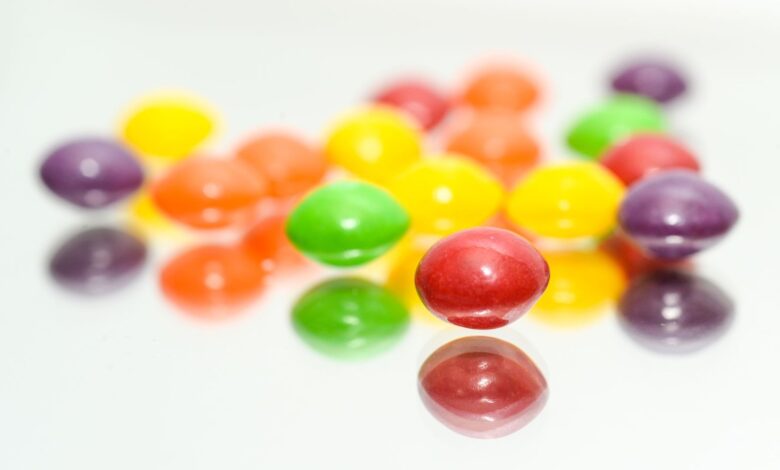
Arrange Skittles in a ring on a white plate, pour in a little warm water, and stripes of colour run towards the middle like the spokes of a wheel. The odd part is that the stripes meet and stay separate for a while instead of blending into a brown puddle. It takes two minutes and works with children as young as three.
What you need
- A bag of Skittles (any coloured, sugar-coated sweets will work, such as M&Ms or Smarties, though the colours behave slightly differently)
- A white plate with a flat base and a slight lip
- Warm tap water in a jug
- A second plate and cold water, if you want to compare
Time: 5 minutes. Age: 3 and up.
Step by step
- Arrange the Skittles in a circle around the edge of the plate, close together. Alternate the colours or group them, whichever you like.
- Pour warm water gently into the middle of the plate until it just covers the bottom of the sweets. Pour slowly so the water does not slosh.
- Keep the plate still and watch for about a minute.
- Colour flows away from each sweet towards the centre. Where two colours meet, look at the boundary between them.
What is happening?
The shell of a Skittle is made mostly of sugar with food colouring in it. Sugar and the colours both dissolve in water, and warm water dissolves them faster.
As the coating dissolves, the water right next to each sweet becomes full of sugar and colour, while the water in the middle of the plate has none. Dissolved substances spread from where there is a lot of them to where there is less, which is called diffusion. So the colour moves inwards, towards the clear water.
The stripes stay separate mainly because the water is still. Every stripe carries about the same amount of sugar, so where two stripes meet there is very little difference between them to push one into the other, and nothing is stirring them together. They do mix in the end, but slowly, and the plate turns murky after a while. Give the plate a shake and the pattern blurs straight away.
The Oregon Museum of Science and Industry describes a version of this activity in its art and science with Skittles guide.
Things to try
- Warm against cold. Set up two plates the same way, one with warm water and one with cold. Which pattern forms faster?
- Other liquids. Try vinegar, milk or fizzy water. Does the sugar still dissolve? Do the colours spread the same way?
- Patterns. Make a rainbow order, a heart shape or two rings of sweets.
- Look at the S. The white S printed on each Skittle often floats off and drifts on the surface. It is printed with an edible ink that does not dissolve in water in the same way.
Safety
- This is one of the gentlest experiments there is. Use warm water from the tap, not from the kettle.
- Once Skittles have been sitting in water on a plate that has been touched, they are not for eating. Have a few spare sweets for afterwards instead.
- Small sweets are a choking risk for children under three.
Make it a fair test
For older children, the experiment can answer a clear question: does the temperature of the water change how fast the colour reaches the centre?
- Use the same plate type, the same number of sweets and the same amount of water for each test.
- Test cold, room temperature and warm water. If you have a kitchen thermometer, record the temperature.
- Start a timer when the water goes in and stop it when the colours first reach the centre.
- Repeat each test three times and take the average.
Most people find that warmer water is faster. The particles in warm water move faster, so the sugar dissolves and spreads more quickly.
Common questions
Why don’t the colours mix in the Skittles experiment?
They do eventually. They stay apart for a while because the water is still and each stripe carries a similar amount of dissolved sugar, so there is little to drive one colour into the next.
Does it work with M&Ms?
Yes. M&Ms and Smarties also have sugar shells coloured with food dyes, so the same thing happens. The chocolate underneath does not dissolve in water, which is why you are left with a pale sweet in the middle.
For more experiments, see our guide to science experiments for kids to do at home.