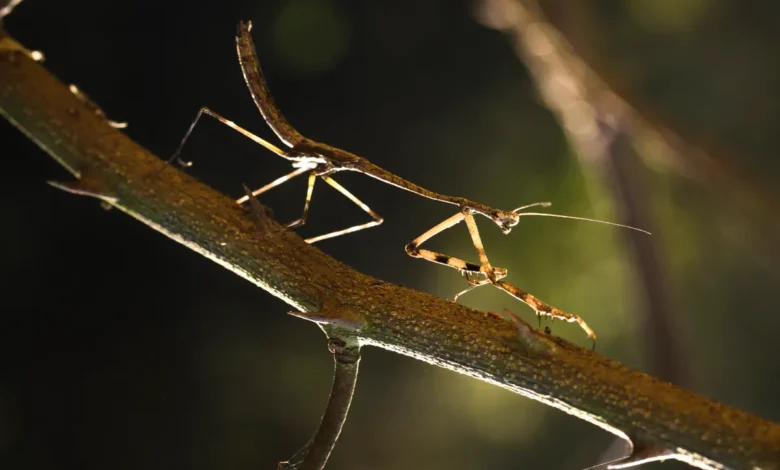
A stick insect known to researchers and enthusiasts across Australia turns out to have been Anchiale robusta misidentified for decades, according to a new study from the University of Sydney that also formally describes two entirely new species within the same genus.
The research, published in Austral Entomology, focused on Australian members of the stick insect genus Anchiale. A team led by postdoctoral research associate Dr Braxton Jones of the Aola Richards Sydney Insect Hub re-examined museum specimens, DNA samples, field survey data, and citizen science records. Their conclusion: what had long been classified as two species is, in fact, five.
How Anchiale robusta was misidentified for decades
The misidentification runs deep. According to ScienceAlert, records of Anchiale robusta stretch back to at least 1976, when its egg case was catalogued under a different species name entirely: Ctenomorphodes briareus, a species that was itself later renamed Anchiale briareus in 2007. The egg case, in other words, was filed under a wrong name that was then itself renamed, compounding the confusion across half a century of records.
The research team cut through that accumulated misclassification using a combination of DNA analysis, captive-reared specimens, and the growing body of citizen science observations submitted through iNaturalist and the Atlas of Living Australia. More than 1,000 such observations exist for Australian Anchiale stick insects, suggesting these are far from obscure or rarely sighted animals. They were simply being seen and logged under the wrong names.
Dr Jones said the findings demonstrate how much can be missed even among well-documented groups. ‘Taxonomy is often a bit like detective work. Even among some of Australia’s most photographed and frequently reported insects, we’re still finding species that have escaped scientific recognition,’ he said.
A new species with an egg structure not seen before
Beyond the correction of Anchiale robusta misidentified for decades, the study formally describes Anchiale mabiensis, found in Queensland’s critically endangered Mabi rainforest on the Atherton Tablelands. Its eggs carry an unusual structural lid that has not been documented in any stick insect or its closest relatives. The researchers also restored a third species that had gone unrecognised, bringing the total number of described Anchiale species in Australia to five, ranging from northern New South Wales along coastal Queensland and into tropical northern Australia.
The newly described egg structure is not merely a curiosity. Egg morphology is among the characteristics taxonomists use to distinguish species, and the lidded egg of A. mabiensis is, by the researchers’ account, without precedent in the group. Whether that structure performs a specific function remains, for now, an open question the study does not resolve.
Practical implications for forestry and land management
The revised species count has consequences beyond taxonomy. One Anchiale stick insect is known to occasionally reach population levels high enough to strip leaves from trees, causing measurable damage. The study found that this insect actually represents more than one species. Distinguishing between them could help land managers and researchers understand the conditions under which outbreaks occur and whether different species behave differently at scale.
The team also notes a possible sixth species from Cape York, though they state they need additional specimens before any formal description is possible.
Funding came from the Australian Biological Resources Study, through the National Taxonomy Research Grant of the Commonwealth Department of Climate Change, Energy, the Environment and Water, and a CSIRO postgraduate scholarship. Dr Jones framed the broader stakes plainly: ‘These findings demonstrate the importance of protecting threatened ecosystems and documenting Australia’s extraordinary biodiversity before we lose species without us having even discovered them.’
The journal reference is: Braxton R. Jones, Paul D. Brock, Ross M. Coupland, Angus Emmott, Nathan Lo. A Revision of Australian Anchiale Stål, 1875 (Phasmida: Phasmatidae), with the Description of Two New Species. Austral Entomology, 2026; 65 (4). DOI: 10.1111/aen.70096.