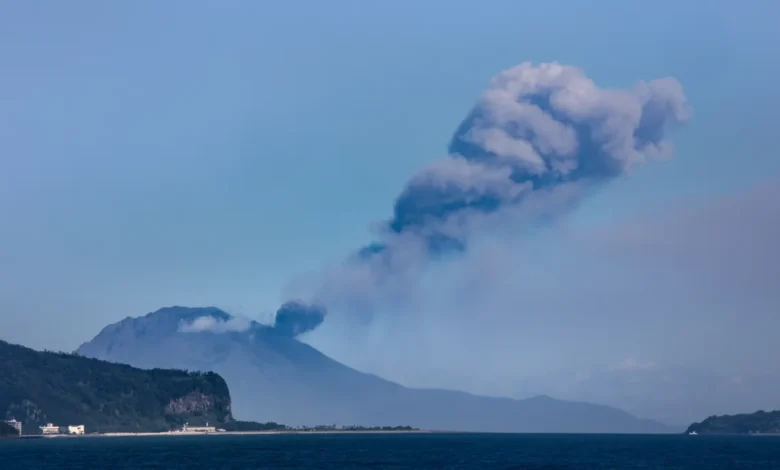
A study published in Nature Communications has found evidence of Hunga Tonga methane destruction on a scale researchers had not previously observed, with satellite instruments tracking the chemistry continuously for more than ten days after the January 2022 eruption. The finding matters because it suggests volcanic ash can accelerate the breakdown of a potent greenhouse gas, and because it raises questions about whether the global methane budget has been correctly calculated.
The claim, put plainly: the enormous stratospheric plume produced by the Hunga Tonga-Hunga Ha’apai eruption appears to have destroyed methane at a rate of approximately 900 megagrams per day for the duration researchers could track it. To put that in terms the researchers themselves used, that daily removal rate is comparable to the methane emissions of two million cows. According to the enrichment data associated with the paper’s abstract via RePec, the total methane oxidation figure is 900 ± 220 Mg/day, implying that at least 330 gigagrams of volcanic methane was injected into the stratosphere. The study itself states the volcano released around 300 gigagrams during the eruption, roughly equivalent to the annual methane emissions of more than two million cows.
What the satellite data actually showed
The detection method rests on formaldehyde, a short-lived chemical that appears briefly when methane is being broken apart. Because formaldehyde survives in the atmosphere for only a few hours, finding it in unusually large quantities acts as a chemical fingerprint for active methane destruction. Maarten van Herpen, a physicist with Acacia Impact Innovation in Heesch, Netherlands, and first author of the study, said researchers were surprised by what they found. ‘When we analysed the satellite images, we were surprised to see a cloud with a record-high concentration of formaldehyde. We were able to track the cloud for 10 days, all the way to South America. Because formaldehyde only exists for a few hours, this showed that the cloud must have been destroying methane continuously for more than a week,’ he said, according to Science News.
The instrument used was TROPOMI, aboard the European Space Agency’s Sentinel-5P satellite. Dr Isabelle De Smedt of the Royal Belgian Institute for Space Aeronomy, one of the co-authors, said that detecting formaldehyde in a stratospheric volcanic plume was ‘far outside the instrument’s standard operating conditions’, requiring corrections for the unusual altitude of the signal and for interference from high sulphur dioxide concentrations. The team concluded those corrections were robust enough to confirm the signal was genuine.
The proposed mechanism behind Hunga Tonga methane destruction
The researchers propose that the chemistry was driven by an unusual combination of volcanic ash, seawater and sunlight. Because the volcano erupted beneath the ocean, it blasted large quantities of salty seawater into the stratosphere alongside ash. The researchers suggest that sunlight striking this mixture produced highly reactive chlorine atoms, which then reacted with methane in the plume and helped break it apart.
The underlying chemical process is not entirely new. As the study notes, scientists had identified in 2023 that Saharan dust crossing the Atlantic can mix with sea salt from breaking waves to form airborne iron salt aerosols. When sunlight strikes those particles, chlorine atoms are released. That earlier finding added what the researchers describe as a previously underappreciated process to understanding of chemistry in the troposphere. Professor Matthew Johnson from the Department of Chemistry at the University of Copenhagen, one of the researchers behind both discoveries, said: ‘What is new, and completely surprising, is that the same mechanism appears to occur in a volcanic plume high up in the stratosphere, where the physical conditions are entirely different.’
Van Herpen also noted that while volcanoes were known to emit methane during eruptions, ‘it was not known that volcanic ash is also capable of partially cleaning up this pollution.’
Implications for the global methane budget
The finding has a direct bearing on how scientists account for methane in the atmosphere. The methane budget estimates how much of the gas enters the atmosphere from sources including wetlands, agriculture, fossil fuels and geological activity, then compares that with known removal processes. Johnson stated that atmospheric dust, such as that from volcanic eruptions, has not previously been fully incorporated into those calculations. ‘It is important that we correct the data on which these estimates are based,’ he said.
Methane currently accounts for about one third of global warming. Over a 20-year period, the gas is about 80 times as potent as carbon dioxide, though it typically remains in the atmosphere for only about ten years. That shorter lifetime is why researchers sometimes describe methane reduction as an ’emergency brake’ on near-term warming, though they are clear it does not substitute for cutting carbon dioxide.
Dr Jos de Laat from the Royal Netherlands Meteorological Institute, senior author of the study, pointed to one further implication: the satellite method itself. ‘How do you prove that methane has been removed from the atmosphere? How do you know your method works? It’s very difficult. But here we address that problem by showing that methane breakdown can in fact be observed using satellites,’ he said. The study was submitted in November 2025, accepted in March 2026, and published on 7 May 2026 in Nature Communications, with the journal material distributed more widely in September 2026.