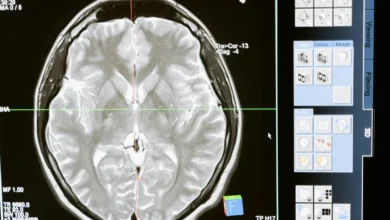
A systematic review of caffeine’s effects on sleep EEG quality suggests that a full night in bed may offer less neurological recovery than it appears, even when the sleeper notices nothing wrong. The review, by James Chmiel of the University of Szczecin and Prof. Donata Kurpas from the Department of Nursing at Wroclaw Medical University, draws on 32 human studies involving caffeine exposure and sleep-related electroencephalography (EEG), according to Daily Coffee News.
The paper, published in the journal MDPI’s Nutrients on 13 April, makes a case that the standard questions about caffeine and sleep (did you fall asleep? did you wake up? how long were you out?) may miss the point. The question that matters more, the authors argue, is what the brain was doing during those hours.
What Caffeine Sleep EEG Quality Research Actually Measures
EEG recordings capture the brain’s electrical activity during sleep in far more detail than self-reported sleep diaries or even basic polysomnography staging can provide. The measure of particular interest here is slow-wave activity: the low-frequency oscillations associated with deep, restorative sleep, the stage during which the body replenishes energy and the brain consolidates memory and clears metabolic waste.
‘EEG allows us to see not only whether a person is sleeping, but also how the brain is sleeping,’ says Prof. Kurpas. ‘Classical sleep assessment assesses sleep duration and its stages, whereas quantitative EEG analysis reveals more subtle changes, such as reduced slow-wave activity, which is an important marker of sleep depth and its restorative character.’
The claim, then, is not that caffeine necessarily keeps people awake. It is that caffeine may suppress slow-wave activity and push the brain’s EEG pattern toward something that looks more wakeful, even while the person remains asleep and unaware of the difference.
‘The subjective feeling of having slept well does not always correspond to what we observe in neurophysiological recordings,’ Prof. Kurpas adds. ‘A person may fall asleep without major difficulty and not remember awakenings, while the brain may display fewer features of deep sleep.’
The Literature Behind the Claims
The review’s scope gives it more weight than a single laboratory study. According to Neuroscience News, the authors conducted a systematic search of databases covering studies published between January 1980 and January 2026, with the final search performed on 10 January 2026. Drawing on that range (four and a half decades of published research) and filtering down to 32 human studies that met their criteria, the authors describe a consistent pattern: caffeine reduces slow-wave activity even when sleep duration remains apparently normal.
That caveat matters. The review is a synthesis of existing literature, not a new controlled trial. It cannot, on its own, settle every question about dose, timing, or population. But the breadth of the search makes it harder to dismiss the finding as an artefact of one small sample.
Individual Variation and the Timing Problem
One of the review’s more practically useful observations concerns individual sensitivity. Genetics, metabolism, age, stress, and chronic fatigue all influence how strongly caffeine affects sleep, the authors note. For some people, coffee consumed earlier in the day may still carry enough residual effect by nightfall to suppress slow-wave activity.
‘It is not only about coffee consumed just before bedtime,’ Prof. Kurpas says. ‘For some people, the total amount of caffeine consumed during the day and whether the body has enough time to metabolize it before nightfall may also be important.’
The practical implication is that a blanket rule (stop drinking coffee after 2pm, or after 4pm, or any fixed hour) will not work equally well for everyone. Sensitivity varies enough that the relevant cutoff for one person may be irrelevant for another.
A Fatigue Cycle That Reinforces Itself
The authors also describe a mechanism by which caffeine’s effect on sleep quality can compound over time. Caffeine temporarily suppresses the perception of fatigue, which is part of its appeal. But if it simultaneously reduces the restorative depth of sleep, the person may wake feeling less recovered, reach for more caffeine to compensate, and in doing so further degrade the next night’s recovery.
‘If caffeine helps a person function during the day while simultaneously worsening the quality of nighttime recovery, a vicious circle may develop: greater fatigue, greater need for stimulation, and poorer sleep,’ Prof. Kurpas says.
This pattern, the authors suggest, may be especially relevant for people who use caffeine regularly to sustain performance, athletes, those in mentally demanding roles, or anyone relying on caffeinated products to stay alert through long days.
Prof. Kurpas stops short of a blanket verdict on caffeine: ‘Caffeine is neither “good” nor “bad”. It is a biologically active substance whose effects depend on dose, time of day, age, lifestyle, sleep quality, stress burden, and individual sensitivity.’ The review, with its 46-year literature window and focus on caffeine sleep EEG quality rather than sleep duration alone, is a methodological argument as much as a scientific finding: if you are only counting hours, you may be counting the wrong thing.