The baking soda volcano is often the first chemistry experiment a child does, and it holds up well: two kitchen ingredients react, a gas is made, and red foam pours down the sides of a model mountain. This version takes about 15 minutes, uses things most kitchens already have, and is safe for young children with an adult helping.
What you need
- An empty small plastic bottle or a jar (a 250 ml drinks bottle is ideal)
- 2 heaped teaspoons of bicarbonate of soda (baking soda)
- About 100 ml of vinegar (any clear vinegar; white vinegar is cheapest)
- A squirt of washing-up liquid
- Red or orange food colouring
- A large baking tray or a washing-up bowl to catch the lava
- For the mountain: modelling clay, play dough, sand, or a paper cone taped round the bottle
- A funnel or a folded piece of paper
Time: 15 minutes, longer if you build the mountain. Age: 3 and up, with an adult helping.
Step by step
- Stand the bottle in the middle of the tray. Build the mountain around it, leaving the top of the bottle open. Children can decorate it with stones or plastic dinosaurs.
- Use the funnel to put the bicarbonate of soda into the bottle.
- Add the washing-up liquid and a few drops of food colouring.
- In a jug, mix the vinegar with a little more food colouring.
- Pour the vinegar into the bottle in one go and step back.
- Watch the foam bubble up and run down the sides. When it stops, add another spoonful of bicarbonate and more vinegar to make it erupt again.
What is happening?
Bicarbonate of soda is a base, and its chemical name is sodium hydrogencarbonate. Vinegar is a weak acid: it is mostly water with about 5% acetic acid (also called ethanoic acid). When an acid and a hydrogencarbonate meet, they react and make three new things: a salt, water and carbon dioxide gas.
sodium hydrogencarbonate + ethanoic acid → sodium ethanoate + water + carbon dioxide
The carbon dioxide is what you see. On its own it would fizz out as clear bubbles. The washing-up liquid traps the gas in a foam, which is thicker and climbs out of the bottle more like lava. The bottle may feel slightly cold afterwards, because this reaction takes in a little heat from its surroundings.
Because a new substance is made, this is a chemical reaction. Compare it with the Mentos and Coke fountain, where gas that was already dissolved in the drink simply escapes.
How is this like a real volcano?
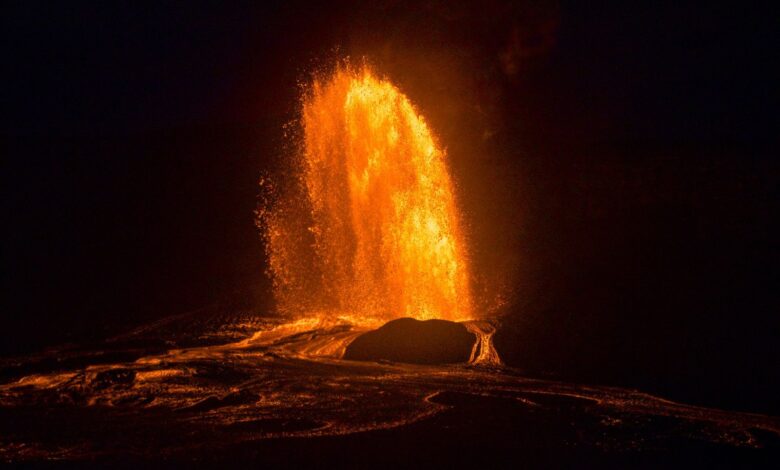
Only partly. A real volcano erupts when molten rock, called magma, rises from deep underground. Magma has gases such as water vapour and carbon dioxide dissolved in it. As it rises, the pressure drops, the gas forms bubbles and expands, and that can drive the eruption. So the gas pushing liquid upwards is a fair comparison.
The big difference is heat. Lava comes out at roughly 700 to 1,200°C, and the eruption is driven by heat and pressure deep in the Earth, not by two ingredients mixing at the top. The Natural History Museum’s guide to making a model volcano has a good explanation of how real volcanoes form.
Safety
- Vinegar stings if it gets in the eyes. Keep faces back from the top of the bottle, and rinse with clean water if any splashes.
- The mixture is not harmful, but it is not for drinking. Supervise small children.
- Food colouring can stain. Use a tray and old clothes.
- When you have finished, the liquid can go down the sink with running water.
Make it a fair test
- Does warm vinegar give a bigger eruption than cold vinegar?
- Does doubling the bicarbonate of soda double the foam?
- Compare vinegar with lemon juice, which contains citric acid.
- Does the width of the bottle neck change how high the foam goes?
Measure the foam by marking the side of the mountain, or collect it in a measuring jug placed in the tray.
Common questions
Can you make a volcano without vinegar?
Yes. Any acid that is safe to handle will react with bicarbonate of soda. Lemon juice works, and so does citric acid powder mixed with water. Fizzy bath bombs use the same reaction with citric acid.
Why does it stop?
One of the ingredients runs out. If adding more vinegar restarts it, the vinegar was used up first. If adding bicarbonate restarts it, the bicarbonate was.
For more experiments, see our guide to science experiments for kids to do at home.