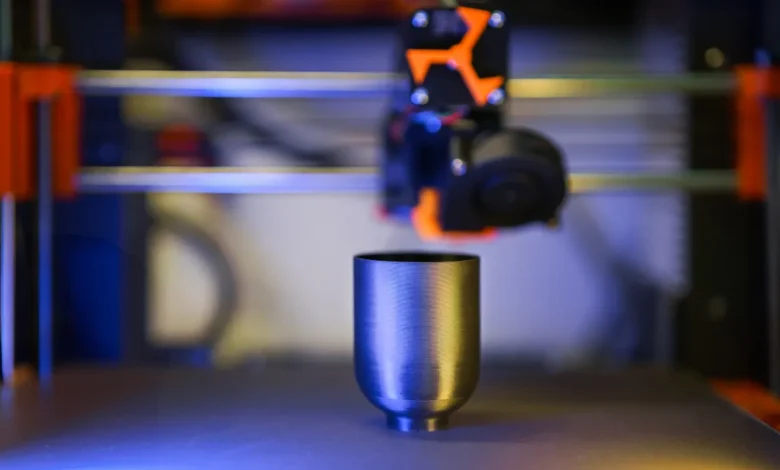
GRCop-42 3D printing AI developed at Washington State University has, the university says, identified six workable printing configurations for a copper-based NASA alloy out of more than 100 million possible settings, doing so in just 40 physical experiments and reaching a record-low laser power of 500 watts. The claim, if it holds up, would matter: ninety per cent of commercial printers currently cannot print the material at all.
The work was published in the Proceedings of the AAAI Conference on Artificial Intelligence and received the Innovative Deployed Application Award at AAAI‘s annual conference. That is a respectable venue, and the prize adds a layer of peer recognition, though neither is a substitute for independent replication in the field.
What GRCop-42 Is and Why Printing It Has Been So Hard
GRCop-42 is an alloy of copper, chromium, and niobium. According to Voxel Matters, NASA developed it in 1987 for harsh environments of the kind found in rocket engine combustion chambers. The material combines high thermal conductivity with the ability to retain its strength at extreme temperatures, which is why it found a home in liquid rocket engine combustion chambers. Voxel Matters also reports that NASA developed parameters for GRCop-42’s use in additive manufacturing in 2017, indicating the agency has long recognised the potential for printed versions of the alloy. Separately, Voxel Matters notes that the alloy can be used to produce parts with oxidation resistance and high creep strength at temperatures as high as 1,400 degrees Fahrenheit.
Despite that history, printing GRCop-42 reliably has remained difficult. The process typically demands substantial laser power, and previous attempts using the lower wattages available on more common commercial machines had not succeeded. A single print can cost hundreds of dollars, and thoroughly analysing the finished sample can require several days. Testing the more than 100 million possible combinations of settings one by one is, as the researchers put it, not a realistic option.
How the GRCop-42 3D Printing AI Strategy Worked
The Washington State University team began with data from 37 configurations that had already failed in earlier experiments. Using those results, their AI model learned to estimate how likely any untested combination of settings was to produce a usable print.
The model then recommended small batches of new configurations to test, balancing two priorities. Some selections targeted configurations that appeared especially promising; others explored less certain areas of the search space to gather information and improve the model’s accuracy. ‘They would give me back the results, and I liked all of them, even if they failed, because every result improved our AI model,’ said Azza Fadhel, first author of the paper and a PhD student in computer science at WSU.
The physical printing work was carried out by Nathaniel Zuckschwerdt, Susmita Bose, and Amit Bandyopadhyay in the School of Mechanical and Materials Engineering, with Aryan Deshwal from the University of Minnesota also contributing. Over three months, and within a total of 40 experiments, the team found six successful configurations at different laser power levels.
‘It’s a very challenging case for AI,’ said Jana Doppa, Huie-Rogers Endowed Chair Professor of Computer Science and Berry Distinguished Professor in Engineering, who led the research. ‘Every time you try, you basically get a binary success or failure signal, and you are trying to minimise the number of tries that you have so that you get to those successful needles very quickly.’
The 500-watt result is presented as a first: GRCop-42 had not previously been printed successfully at that power level. Lower laser power, the team says, could reduce energy consumption, decrease wear on printing equipment, and lower the costs of post-print sample processing. More broadly, it could bring the alloy within reach of universities, smaller laboratories, and companies that lack high-power specialist systems.
The Broader Claim: A Method for Other Hard Problems
‘Ninety per cent of commercial printers cannot print this metal alloy, so given that we were able to find these feasible process parameters, it allows us to use those commercial printers, and we are essentially democratising the printing of this alloy,’ Doppa said. The team also argues the same approach could be adapted for other metal alloys and additive manufacturing systems, and potentially for problems in drug discovery and other areas where each experiment carries substantial material or financial cost.
Those are wide claims for a study built on 40 experiments. The researchers acknowledge the uncertainty themselves. ‘There’s always uncertainty when you are deploying something where real people, materials, and physical costs are involved,’ Doppa said. ‘I was very surprised that we were able to do this so well.’
The paper is published in volume 40, issue 47 of the Proceedings of the AAAI Conference on Artificial Intelligence (DOI: 10.1609/aaai.v40i47.41428). Independent testing of the six configurations across different printing environments would be the natural next step for anyone assessing whether the results transfer beyond WSU’s own equipment.