The claim is as arresting as it is carefully hedged: observations of a distant magnetar may represent the first direct vacuum birefringence magnetar evidence, potentially confirming a quantum prediction Werner Heisenberg made nearly 90 years ago. The findings, published in Nature, carry the word ‘may’ throughout, and the researchers are the first to say a definitive detection has not yet been made.
Vacuum birefringence is the idea that apparently empty space is not truly empty. The theory holds that a perfect vacuum contains ‘virtual particles’ that briefly appear and disappear, and that an extraordinarily powerful magnetic field can align those particles in ways that alter how light travels through them. The effect has been predicted since the 1930s. It has never been confirmed.
Why a magnetar, and why this one
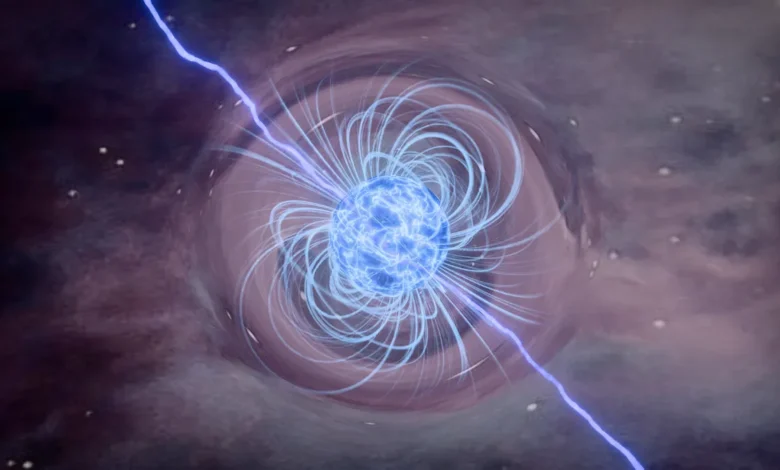
The difficulty is not theoretical. It is practical. As Dr Marcus Lower, one of the researchers involved and based at Swinburne University of Technology, put it: ‘Detecting vacuum birefringence requires a magnetic field that is over 100 million times stronger than any we’ve ever made on Earth.’ Magnetars, a rare class of neutron star, possess the strongest magnetic fields known anywhere in the universe, which is why the team turned to one.
The specific target was the magnetar designated 1E 1547.0-5408. According to NASA, this object has a rotation period of 2.1 seconds, and it offered the research team something beyond raw magnetic power: geometry. Radio observations showed that the magnetar’s magnetic and rotational axes are almost aligned, and the object is observed from a nearly pole-on perspective. That combination gave scientists an unusually clean line of sight for searching for the predicted quantum signature.
‘Because of the magnetic field’s strength, Heisenberg’s virtual particles become aligned with the direction the field is pointing,’ Dr Lower said. ‘By carefully tracking the direction the radio waves and X-rays oscillate as the magnetar rotates, the team found that the alignment of 1E1547’s magnetic and rotational poles were ideal for detecting vacuum birefringence.’
More than 140 hours of X-ray observation
The observational effort was substantial. NASA reports that its Imaging X-ray Polarimetry Explorer (IXPE) conducted more than 140 hours of observations of 1E 1547.0-5408, collected between March and April 2025. Those figures, cited by Nature World News, give some sense of the investment required to pursue a signal this faint and this contested.
IXPE was not the only instrument involved. The NICER X-ray telescope aboard the International Space Station contributed supporting observations, as did Murriyang, CSIRO’s Parkes radio telescope. Radio data collected by Dr Lower using Murriyang were subsequently analysed on Swinburne’s Ngarrgu Tindebeek supercomputer. The multi-instrument approach matters because the team was not just searching for polarisation; they were tracking whether polarisation behaviour in X-rays matched what the radio data suggested about the magnetar’s geometry.
Two results pointed toward the quantum effect. X-rays detected by IXPE showed extremely high levels of polarisation. And the direction of that polarisation remained tied to the magnetar’s magnetic field in the same way observed in the radio data. The internal consistency is what the team is leaning on, though they stop well short of calling it a confirmed detection.
What confirmation would actually require
The paper’s hedged language is not diplomatic caution; it reflects a genuine methodological gap. Dr Lower said additional observations and more advanced computer simulations would be needed to establish whether the signal truly comes from vacuum birefringence, rather than from other physical processes taking place around the magnetar. The quantum signature and some non-quantum alternatives have not yet been cleanly separated.
‘With these future data on hand and our updated simulations, we may finally be able to complete the quest started by Heisenberg nearly 90 years ago,’ Dr Lower said.
If confirmed, the team says the result could give physicists a new way to test how established theories of quantum physics behave under extreme conditions. For now, the search for vacuum birefringence magnetar evidence has a credible candidate, a precise observational dataset, and an explicit research programme for what comes next. The case is open, not closed.