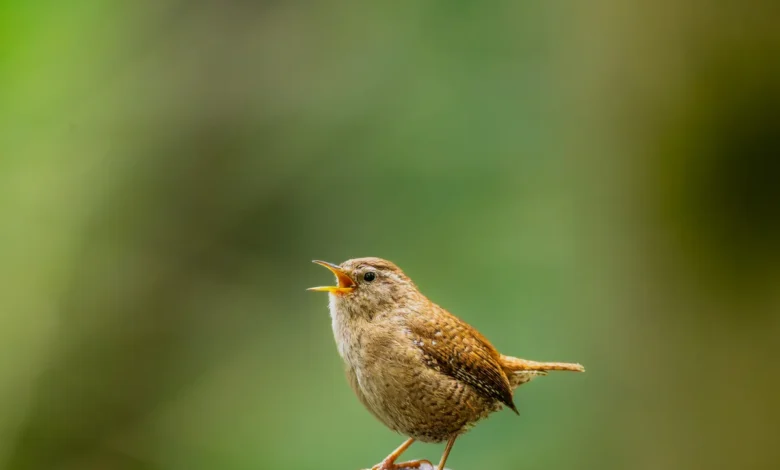
Scientists are exploring whether AI-generated recordings and live tutors can help birds relearn songs that have been lost as populations decline, research that could matter for the survival of species whose members can no longer find or learn from enough experienced singers. The Guardian reports that the case drawing most attention involves the rufous-collared sparrow: researchers in Buenos Aires played a computer-generated version of a local song that had disappeared from a park since the 1960s, and within three months a resident bird had begun copying parts of it.
The work on that sparrow, carried out by Gabriel B Mindlin, professor of physics at the University of Buenos Aires, was published as a 2024 study in Physica D: Nonlinear Phenomena, according to National Geographic, which reported in March 2025 that Mindlin, also director of the Institute of Interdisciplinary and Applied Physics (INFINA) at UBA, co-authored it with Ana Amador and Roberto Bistel. Mindlin reconstructed the song from hand-drawn annotations made in the 1960s. Some of the themes recorded then are still sung locally; others have died out, for reasons that are not clear, though Mindlin notes the bird population in the park had declined.
Why birdsong matters for survival
The stakes are practical. About 4,000 of the world’s 10,000 bird species are songbirds, including finches, sparrows and blackbirds, whose complex songs are at least partly learned from other individuals. If a population falls, there are fewer experienced singers for fledglings to copy. Birds may then produce abnormal songs or accidentally learn the calls of other species, reducing their chances of finding a mate and breeding.
Rebecca Lewis, a conservation scientist at Chester Zoo, puts the basic mechanic plainly: ‘If your song requires a lot of energy you might have to be in quite a good condition to sing it.’ A well-performed, complex song in the local dialect signals fitness to potential mates and helps a bird hold territory. Mindlin frames the wider implication: ‘When people talk about biodiversity, we’re always talking about genes, about genetic material,’ but learned behaviour (culture, including song) is also an essential part of a population.
Separate research has identified common structural elements across the broader group of passerine birds, including trill motifs in three forms, three varieties of whistle, and two further categories: chaotic notes and harmonic notes. How species use these building blocks reflects where they evolved. Flat whistles are more common among birds in tropical rainforests, where sound must travel through dense vegetation; complex ultrafast trills are more frequent in temperate regions where birds communicate at closer range.
Tutors, translocation and the limits of playback
Two other studies in the source article illustrate what works and what does not. Sarah Collins, associate professor of animal behaviour at the University of Plymouth, tracked cirl buntings translocated from Devon to Cornwall as part of a conservation project. The birds initially produced songs described as ‘squeaky and slow’ and far less diverse than those of the Devon source population: ‘They didn’t have the richness of sound,’ Collins says. Eight years later their songs had returned to something normal, though it is unclear whether other species would recover in the same way, and Collins is cautious about generalising.
A study in Australia offered a more direct test of tutoring. Regent honeyeaters bred in zoos, helping to support a critically endangered wild population that had fallen to about 250 individuals, learned to sing wild songs after interacting with just two wild-born male tutors. Zoo-bred males that had learned the traditional songs then went on to teach the next generation.
Collins notes a consistent limitation of recorded playback alone: ‘Sometimes birds don’t learn very well from CDs or just playbacks. They need some sort of interaction.’ Bringing wild birds into captivity to act as tutors carries its own risks, however, potential distress and disease transmission in an already endangered population. It is possible, the source article states, that AI could help provide live tutoring in future, though this remains at the exploratory stage.
Dialect presents a further complication. Lewis notes that in past translocation projects, ‘birds with mismatched songs don’t pair quite as quickly or do quite as well once they’re paired.’ Familiarising birds with the songs of their destination area can help, but is not a guaranteed fix.
In Buenos Aires, the recovered song from the 1960s is still being heard. ‘It’s still being sung by just a few individuals, pretty close to where we inserted it,’ Mindlin says, adding that only time will tell how long it persists.